Lecture 1 Video 7 Polarized Light Summary
🌈 Polarized Light — Complete Conceptual Summary
1. 🌊 Light as an Electromagnetic Wave
Light is an electromagnetic (EM) wave, meaning it consists of two oscillating fields:
- ⚡ Electric field (E-field)
- 🧲 Magnetic field (B-field)
Key properties:
- The E-field and B-field oscillate perpendicular to each other
- Both are perpendicular to the direction of propagation
- The wave travels forward while the fields oscillate sideways
📌 If light propagates along the z-axis, then:
- The E-field oscillates in the x–y plane
- The B-field oscillates in a direction perpendicular to the E-field


2. 🧭 Freedom of Oscillation Directions
There is no preferred direction for the electric field oscillation in space.
- The coordinate system is arbitrary
- The electric field can oscillate:
- Vertically
- Horizontally
- At any angle in between
👉 This freedom leads directly to different polarization states of light.
3. ☀️ Non-Polarized Light
Non-polarized light contains all possible oscillation directions of the electric field.
Examples:
- Sunlight
- Light bulbs
- Most natural light sources
Characteristics:
- The E-field direction changes randomly over time
- No single preferred oscillation plane
📌 This is the default form of light we encounter in daily life.
4. 📐 Linearly Polarized Light
When the electric field oscillates in only one fixed direction, the light is linearly polarized.
- The oscillation direction does not change with time
- The exact direction does not matter (vertical, horizontal, diagonal)
Terminology:
- Often simply called “polarized light”
- More precisely: linearly polarized light


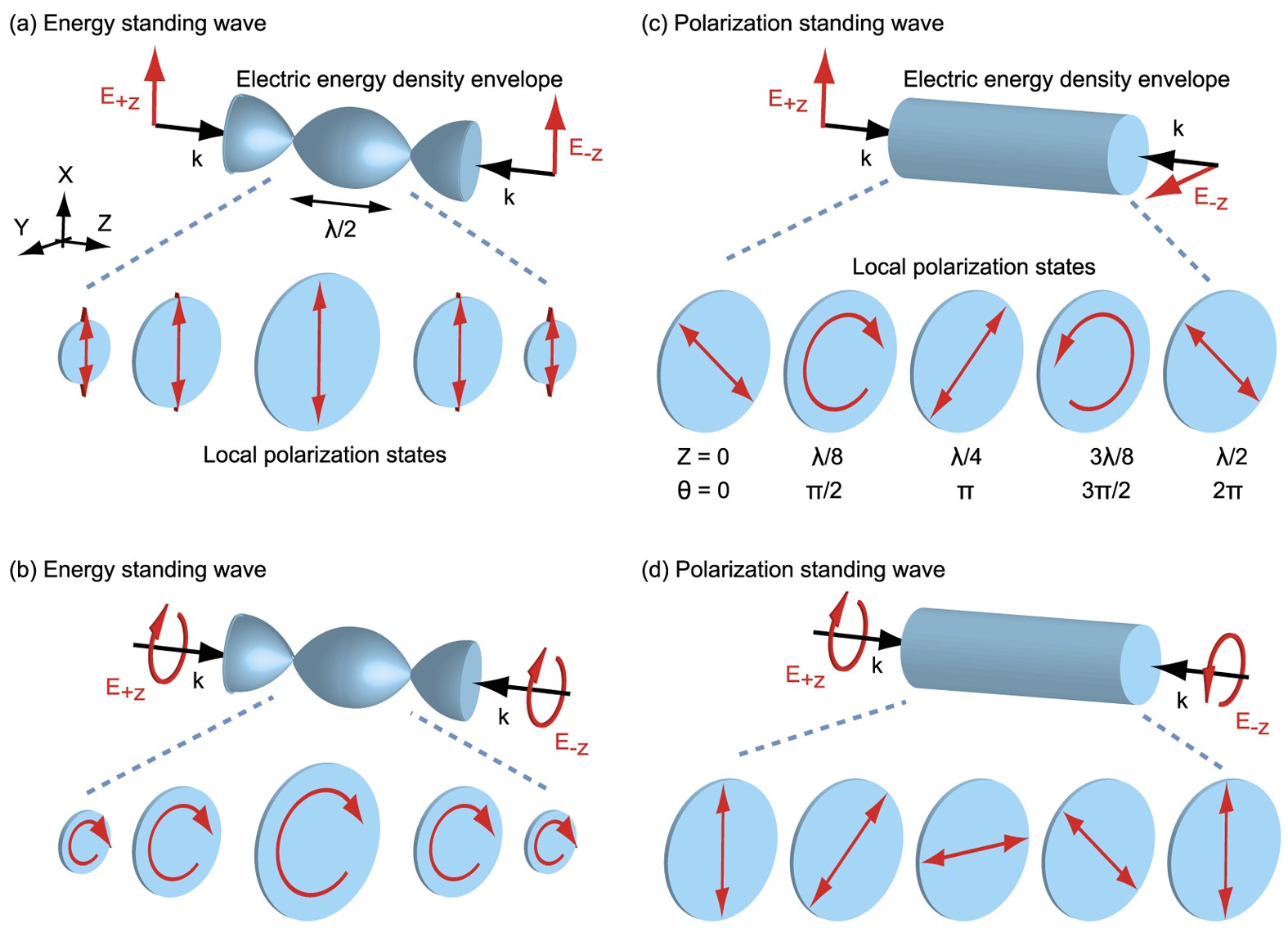
5. 🌀 Circularly Polarized Light
There is another, more complex polarization state: circular polarization.
Instead of oscillating back and forth:
- The electric field vector rotates continuously
- It traces a helix around the propagation axis
Types:
- 🔄 Left-handed (counterclockwise) circular polarization
- 🔁 Right-handed (clockwise) circular polarization
⚠️ Important viewing rule:
- You must look along the direction of propagation, from behind the wave, to define left vs right

6. ➕ Superposition: Circular → Linear
A key conceptual insight:
Linearly polarized light is a superposition of left-handed and right-handed circularly polarized light
How this works:
- Both circular components start aligned
- As they rotate in opposite directions:
- One component’s x-projection cancels the other
- Only the y-component remains
🎯 Result:
- The remaining oscillation is linear
- This is not just mathematics — it physically occurs

7. 🔬 Why This Matters: Circular Dichroism
This superposition principle becomes experimentally important in circular dichroism (CD).
Core idea:
- Materials (especially chiral molecules) may absorb:
- Left-handed circularly polarized light
- Right-handed circularly polarized light
- Unequally
Consequences:
- The balance between left/right circular components changes
- This alters the resulting linear polarization
- Enables detection of molecular structure and chirality
📌 This is the physical basis behind CD spectroscopy, widely used in:
- Protein secondary structure analysis
- Biochemistry and biophysics
🧠 One-Glance Mental Model
- 🌞 Natural light → non-polarized
- 📐 Single oscillation direction → linear polarization
- 🌀 Rotating E-field → circular polarization
- ➕ Left + right circular → linear polarization
- 🔬 Different absorption of circular components → circular dichorism
✅ Key Exam Takeaways
- Polarization refers to the directional behavior of the electric field
- Linear polarization is not fundamental, but composed
- Circular polarization introduces handedness
- Superposition is physically real, not just mathematical
- CD relies directly on these polarization principles